
Marketing vs. Advertising: They Are Not the Same Thing, and Yes, Both Matter
Marketing and advertising are connected, but they are not interchangeable. This post explains how marketing creates the strategy, message, audience understanding, and customer journey, while advertising provides the paid visibility to amplify that message. Using a simple party analogy, it shows why advertising works best when it has a clear marketing foundation behind it.



Marketing and advertising get used interchangeably all the time.
People say things like:
“We need to do more marketing.”
And what they actually mean is:
“We should run ads.”
Or they say:
“Our advertising is not working.”
And what they really mean is:
“Our message, audience, offer, website, content, positioning, and follow-up process may all be confusing people before the ad ever had a chance.”
Cute little mix-up.
Except not really.
Because when businesses confuse marketing and advertising, they often end up spending money in the wrong place, solving the wrong problem, and blaming the wrong tactic.
So let’s make this simple.
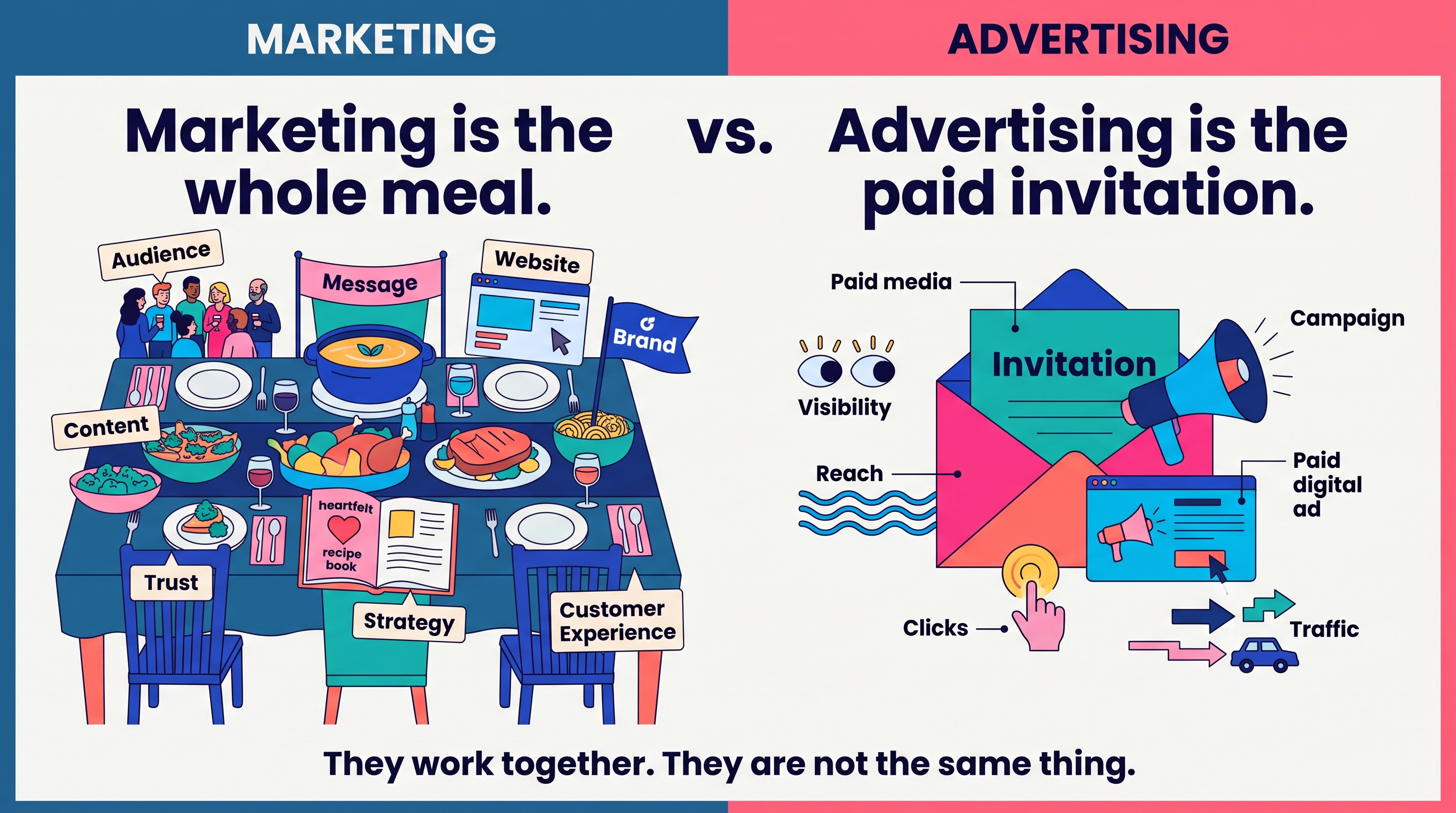
Marketing is the whole meal.
Advertising is the paid invitation to come eat.
Both matter. But they are not the same thing.
Marketing Is the Strategy Behind the Relationship
Marketing is everything your organization does to understand, attract, communicate with, and create value for the people you are trying to reach.
It is the thinking behind the work.
Marketing answers questions like:
Who are we trying to reach?
What do they care about?
What problem are we solving?
Why should they choose us?
How do we explain our value?
Where do they spend time?
What do they need to believe before they act?
What experience do they have after they find us?
How do we build trust over time?
Marketing is not just promotion.
Marketing includes your brand positioning, messaging, audience strategy, website, content, customer experience, pricing perception, reputation, email strategy, social media presence, SEO, partnerships, events, community building, thought leadership, and yes, advertising.
Marketing is the entire system.
It is the reason someone understands who you are, remembers you, trusts you, and eventually decides to work with you, buy from you, donate to you, refer you, or come back again.
Advertising is one part of that system.
Advertising Is Paid Visibility
Advertising is the act of paying to place your message in front of a specific audience.
Google Ads.
Meta ads.
LinkedIn ads.
TikTok ads.
Billboards.
Radio.
Streaming audio.
TV.
Print.
Sponsorship placements.
Display ads.
Retargeting.
Paid search.
Paid social.
That is advertising.
Advertising helps you get attention faster.
It can drive awareness, traffic, leads, purchases, applications, donations, sign-ups, store visits, event registrations, and all kinds of measurable action.
But advertising is not magic.
Advertising can amplify a message.
It cannot fix a weak one.
Advertising can drive people to your website.
It cannot make the website clear.
Advertising can get you in front of the right audience.
It cannot automatically make that audience care.
Advertising can create visibility.
It cannot replace trust.
This is where a lot of businesses get themselves in trouble. They think the ad is the whole strategy.
It is not.
An ad is a megaphone.
And if your message is confusing, the megaphone just makes the confusion louder.
I Like To Use The Party Analogy
Think of marketing like planning a party.
Marketing decides:
Who the party is for
Why they would want to come
What kind of experience they should have
What food makes sense
What music fits the vibe
What the invitation should say
What the room should feel like
How people will know where to go
What they will remember after they leave
Advertising is paying to send the invitation.
Important? Absolutely.
But imagine paying to send 10,000 invitations to a party where:
The address is wrong
The theme is unclear
The food is random
No one knows where to park
The host forgot why people were invited
The music is giving “dentist waiting room”
And the follow-up plan is “hope everyone had fun”
That is what happens when you advertise without marketing strategy.
You may get people to show up.
But then what?
Why Marketing Needs Advertising
Now, before the organic-content-only people get too comfortable, let’s be clear: advertising has a real job.
Marketing without advertising can work, but it is often slower.
You can have the clearest message in the world, but if no one sees it, we have a visibility problem.
Advertising helps create momentum.
It can help you reach people who do not already know you. It can support launches, campaigns, seasonal pushes, recruitment, fundraising, sales, events, retargeting, and market expansion.
A strong marketing strategy gives advertising something worth amplifying.
It gives the campaign direction.
It tells us who we are targeting, what we want them to do, what message should matter, where to reach them, and how success should be measured.
Without marketing, advertising is just money with a media plan.
And money deserves a job.
Why Advertising Needs Marketing
Advertising needs marketing because ads do not exist in a vacuum.
Someone sees an ad.
Then they may click.
Then they may land on your website.
Then they may read your copy.
Then they may check your social media.
Then they may look for reviews.
Then they may compare you to someone else.
Then they may talk to a partner, board member, spouse, boss, or group chat.
Then they may come back three weeks later.
That entire journey is marketing.
The ad may start the conversation, but marketing carries it.
So when an ad campaign does not perform, the answer is not always “the ads were bad.”
Sometimes the audience was wrong.
Sometimes the offer was unclear.
Sometimes the landing page was doing too much.
Sometimes the message was too generic.
Sometimes the brand did not feel credible.
Sometimes the call to action was weak.
Sometimes people were interested, but not ready.
Sometimes tracking was messy.
Sometimes the ads were fine, but the strategy underneath them was held together with duct tape and hope.
This is why we do not start with tactics.
We start with strategy.
Marketing and Advertising Work Best Together
Marketing and advertising are different, but they are deeply connected.
Marketing creates the foundation.
Advertising creates targeted visibility.
Marketing defines the message.
Advertising distributes it.
Marketing builds trust.
Advertising accelerates reach.
Marketing shapes the customer journey.
Advertising helps move people into that journey.
Marketing sustains momentum.
Advertising can fuel growth.
You need both, but you need them in the right order.
Strategy before tactics.
Message before media.
Clarity before spend.
Because when marketing and advertising work together, the work becomes more intentional. The audience gets a clearer message. The budget has a better chance of doing its job. And the organization stops confusing activity with progress.
The Real Problem Is Usually Not “We Need More Ads”
A lot of organizations come in thinking they need more advertising.
Sometimes they do.
But often, what they really need first is clearer marketing.
They need to know who they are talking to.
They need to clean up their message.
They need their website to explain the value better.
They need a stronger content strategy.
They need to understand what their audience actually cares about.
They need to stop saying five different things in five different places.
They need a roadmap.
Then advertising can do what advertising is supposed to do.
This is the difference between throwing money at visibility and building marketing that actually makes sense.
So, What Should You Do First?
Before you run the ad, ask:
Is our audience clear?
Is our message clear?
Is our offer clear?
Is our website ready?
Is the next step obvious?
Do we know what success looks like?
Do we know how this supports the bigger business goal?
If the answer is no, pause.
That does not mean you should never advertise.
It means the advertising needs a stronger foundation.
Because marketing and advertising are not interchangeable words.
They are different tools with different jobs.
Marketing is the strategy, relationship, message, and system.
Advertising is the paid visibility that helps amplify the right message to the right people at the right time.
Both matter.
But when you confuse them, you waste time, money, and energy.
And random acts of marketing are expensive enough already.
No pressure. No hard sell. Just a real conversation.
Ready to make sense of your Marketing & Advertising efforts?