Strategy Before Tactics: Because Buying Ingredients Is Not the Same as Making Dinner
Why do businesses keep investing in websites, ads, and content without a clear plan? Using a relatable grocery-shopping analogy, Yeliza explains the difference between strategy and tactics, why disconnected marketing gets expensive, and how businesses and nonprofits can make smarter decisions by starting with their goals, audiences, and priorities.
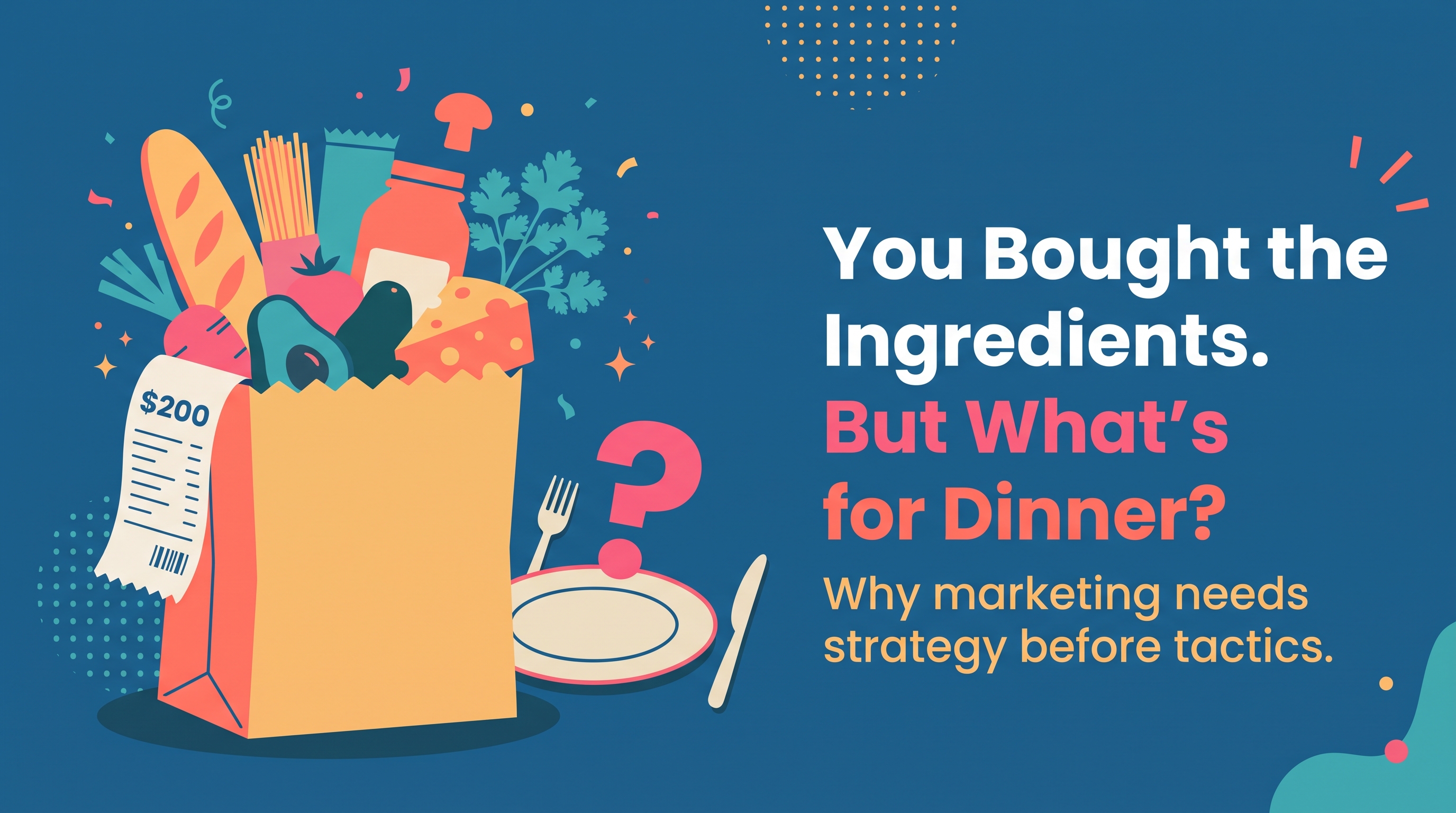



You know that feeling when you walk into the grocery store hungry, without a list, and suddenly everything looks like a good idea? You grab the fancy cheese. The organic avocados. A bag of lettuce because you're going to "start eating healthier this week". Some pasta. A rotisserie chicken. A new sauce you saw on TikTok.
You spend $200, get home, unload your groceries, and then ask yourself the same question you were supposed to answer before you left: What the hell are we having for dinner?
Congratulations.
You've just experienced what marketing looks like without a strategy. And if you're a business owner, nonprofit leader, or anyone responsible for making marketing decisions, there's a good chance you've done the professional version of this. You've bought the ingredients. Maybe you've even hired a chef. But nobody decided what was on the menu.
The Difference Between Strategy and Tactics
Let's get something straight. Strategy and tactics are not interchangeable. They're related. They need each other. But they have very different jobs.
Strategy determines where you're going, why you're going there, who you're trying to reach, and what you're going to prioritize to get there.
Tactics are the specific actions you take to execute that strategy.
In marketing, strategy might involve understanding your audience, clarifying your positioning, identifying growth opportunities, choosing the right channels, developing your message, setting priorities, and defining what success looks like.
Tactics are the things you actually do.
You redesign the website.
You launch the advertising campaign.
You publish the blog post.
You send the email.
You create the social media content.
You attend the trade show.
You optimize for SEO, AEO, and GEO.
You produce the video.
You build the landing page.
All perfectly legitimate activities. But none of them automatically qualifies as a strategy. And that's where things get messy. Because being busy with marketing is not the same as being strategic about marketing.
Let's Go Back to the Grocery Store
Imagine you're hosting dinner for eight people. Before you start shopping, you'd probably want to know a few things.
Who's coming?
Does anyone have dietary restrictions?
What's the occasion?
What's the budget?
Are we doing casual tacos or a five-course experience?
Do you actually know how to cook?
These questions determine what goes on the menu. Once you know the menu, you can write the grocery list, buy the right ingredients, decide what to prepare first, and figure out whether you need help. That's strategy informing execution.
Now imagine skipping all those questions and buying whatever looks good. You could end up with an impressive collection of ingredients and still have no dinner. That's what happens when organizations say:
"We need a new website."
"We should start posting on TikTok."
"Let's run some Google Ads."
"We need a new logo."
"Someone told us we should be using AI."
"We should sponsor that event."
"We need to send more emails."
Maybe! But... WHY?
What problem are we solving?
Who are we trying to reach?
What outcome are we working toward?
What will that tactic contribute?
And why is it the right investment right now?
If you can't answer those questions, you may be shopping without a recipe.
Random Acts of Marketing Are Expensive
One of the most common mistakes I see is organizations confusing activity with progress.
They produce content because the calendar says they should.
They redesign websites because the current one feels old.
They launch campaigns because they need more leads.
They jump on trends because a competitor is doing something interesting.
They invest in platforms because someone promised better results.
And six months later, everyone is exhausted, the budget is lighter, and leadership is asking: "So... is any of this working?"
That's a fair question. But it's also a question that should have been considered before the spending began. Marketing budgets don't disappear all at once... they leak.
A little money here.
A new platform there.
A contractor.
An ad campaign.
A website update.
Three subscriptions no one remembers approving.
A social media calendar filled with content that looks nice but doesn't support a meaningful business objective.
Individually, these decisions may seem reasonable. Collectively, without a strategy, they can become an expensive collection of disconnected efforts. And to be clear, the people executing those tactics may be doing excellent work.
Your designer may be brilliant.
Your social media manager may be creating fantastic content.
Your advertising specialist may be running efficient campaigns.
But even great execution can struggle when everyone is working toward a different understanding of success.
Good tactics cannot compensate for missing direction.
Strategy Is Not a Beautiful Presentation That Collects Dust
Now, before someone accuses me of suggesting every business needs a 100-page strategic plan and a three-day leadership retreat, let me stop you.
No.
Strategy doesn't have to be complicated.
But tt does have to be intentional.
For one organization, that might mean a comprehensive strategic planning process involving leadership, audience research, competitive analysis, stakeholder input, positioning, messaging, measurement, and a multi-year marketing roadmap. For another, it might mean taking a focused look at the current business, identifying the most valuable customer segment, clarifying the message, and creating a practical 90-day action plan. The depth depends on the problem. The goal is not to produce the most impressive document. The goal is to make better decisions.
A useful strategy should help you determine:
- What matters most right now.
- Which audiences deserve your attention.
- What makes your organization valuable and different.
- What your audience needs to understand or believe.
- Which marketing opportunities deserve investment.
- Which tactics make sense and which don't.
- How you'll know whether the work is helping.
And perhaps most importantly: What are we NOT going to do?
Because strategy isn't just deciding where to invest.
It's having the discipline to stop investing in things that don't support the goal.
Sometimes the smartest marketing move is saying no.
Even when the idea is cute.
Even when the trend is trending.
Even when your competitor is doing it. Especially when your competitor is doing it and nobody knows why.
Example: The Business That Thinks It Needs More Advertising
Let's say you own a growing home services business.
Revenue has plateaued.
You want more customers.
Naturally, someone suggests running more ads.
That sounds reasonable.
But before we start spending, let's look at the bigger picture.
Who is your most profitable customer?
Which services generate the healthiest margins?
Which geographic areas offer the greatest opportunity?
Are customers finding you but choosing competitors?
Is your website helping them understand why they should trust you?
Are you following up with leads quickly enough?
Are existing customers coming back or referring others?
Maybe advertising is exactly what you need. Or maybe your biggest opportunity is improving your website's messaging, building stronger local search visibility, creating a referral program, or promoting your most profitable service instead of everything you offer.
Same business problem.
Very different potential solutions.
That's why we diagnose before we prescribe. Because spending more money on the wrong solution doesn't make it the right solution. It just makes the mistake more expensive.
Nonprofits, You're Not Exempt
The same principle applies to nonprofit organizations.
Maybe you need more donors.
Or volunteers.
Or program participants.
Or community awareness.
The instinct might be to launch a fundraising campaign, redesign donation materials, increase social media activity, or host another event.
Again, all reasonable possibilities.
But first:
Do your audiences understand your mission?
Can your leadership team explain your organization's value consistently?
Do potential donors understand the impact of their contributions?
Are you speaking to different audiences as though they all care about the same things?
Do your programs, development efforts, and communications share the same priorities?
Are you asking people to participate without first giving them a compelling reason to care?
More marketing isn't automatically the answer.
More aligned marketing might be.
And when resources are limited, strategic prioritization becomes even more important.
Your mission deserves better than crossed fingers and a Canva subscription.
Strategy Gives Tactics a Job
Here's the beautiful thing about strategy.
It doesn't make creativity less important.
It makes creativity more useful.
When the direction is clear, designers know what the work needs to communicate.
Writers understand who they're speaking to.
Media planners know what audiences and outcomes matter.
Website teams understand what the visitor needs to do.
Internal teams can prioritize.
Leadership has a framework for making decisions.
And measurement becomes more meaningful because you've defined what you're trying to achieve.
The work doesn't become boring.
It becomes connected.
A brilliant idea is still welcome.
It just has to answer the question: What job is this idea supposed to do?
At Integral, we believe creativity and strategy are at their best when they challenge and strengthen one another.
Strategy provides the direction.
Creativity helps make that direction compelling.
Execution brings it into the world.
Measurement helps us learn what to do next.
That's how you build momentum rather than just manufacture activity.
What About Experimentation?
I'm glad you asked.
Because if you know me, you know I am not opposed to trying new things.
Quite the opposite.
I love a bold idea.
I love testing assumptions.
I love experimenting with new tools, messages, formats, and channels.
I am very much a "let's mess around and find out" kind of strategist. Or umm as I like to say: FAFO!
But here's the distinction: Experimentation with a purpose is strategy. Random activity without a purpose is guessing.
A good experiment starts with a hypothesis.
We believe this audience might respond to this message.
We believe this channel could help us reach a new market.
We believe simplifying the website experience could improve conversions.
We believe this content approach might strengthen engagement.
So we test.
We measure.
We learn.
We adjust.
Sometimes we're right.
Sometimes we're spectacularly wrong.
Either outcome can teach us something useful.
But only if we knew what we were trying to learn in the first place.
So, How Do You Start Thinking Strategically?
Before your next marketing investment, ask yourself five questions.
1. What business or organizational goal are we trying to support?
Not "we need more engagement."
Why do we need that engagement? What meaningful outcome should it help create?
2. Who specifically needs to take action?
Customers? Donors? Patients? Students? Members? Referral partners?
"Everyone" is not an audience strategy.
3. What do those people need from us?
What are they trying to accomplish? What stands in their way? What makes our organization relevant to them?
4. What is preventing the desired action today?
Is it awareness? Understanding? Trust? Access? Timing? Experience? The offer itself?
Different barriers require different solutions.
5. Which marketing actions are most likely to make a meaningful difference?
Now we can discuss websites, advertising, content, social media, SEO, email, events, and everything else.
Notice how the tactics came last?
There's a reason for that.
All-In-All
I'm not telling you to stop creating content.
Or stop advertising.
Or stop redesigning websites.
Or stop trying new things.
I'm telling you to stop treating those activities as though they are strategies all by themselves.
The strongest marketing doesn't begin with "What should we do?"
It begins with "What are we trying to accomplish, and why?"
Then we decide what to do.
Because marketing should be intentional.
Your resources should have a purpose.
Your team should understand the direction.
Your audience should receive a consistent experience.
And your budget should not be wandering the grocery store hungry, grabbing whatever looks good.
Strategy Before Tactics.
Make the menu.
Write the list.
Then go shopping.
And please, for the love of good marketing, stop buying cilantro without knowing what you're cooking.
Ready to stop guessing?
Integral helps growing businesses and nonprofits clarify their priorities, understand their audiences, and build marketing roadmaps that turn scattered activity into focused action.
No pressure. No hard sell. Just a real conversation.
Ready to make sense of your Marketing & Advertising efforts?